How early engagement and an integrated CDMO-CRO model expedites drug development

Biotech and pharmaceutical organizations face a development landscape that is increasingly complex, resource-intensive, and risk-laden. Today’s molecules, particularly in oncology, neurology and other advanced modalities, demand sophisticated scientific, operational, and regulatory strategies executed with precision. Yet, traditional multi-vendor models often fragment accountability, slow program progress, and create costly inefficiencies.
Speed is rapidly becoming a critical success factor in modern drug development. A growing body of evidence now demonstrates that early engagement with a single, integrated CDMO–CRO partner can materially increase both time savings and financial return. When executed effectively, full-service integration can compress timelines, improve continuity, reduce risk, and unlock substantial financial value.
Integration has become a strategic imperative for companies operating in highly competitive therapeutic areas, where months matter and delays translate into tens of millions of dollars in wasted resources and lost opportunity.
Integration leverages the financial power of time
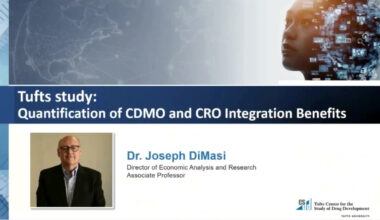
Recent economic modeling by the Tufts Center for the Study of Drug Development demonstrates the significant financial impact of integrating CDMO and CRO functions under a single provider. Using industry benchmarks and operational data from integrated development programs, researchers quantified the effect on expected net present value (eNPV) and return on investment (ROI) across oncology portfolios.
The findings are clear:
- Clinical phase durations can be reduced by 7–15 months, depending on phase and modality.
- These time savings translate to eNPV gains from approximately $1.5M to $63M per oncology indication (mAbs).
- ROI is exceptionally strong—often 10–100x the investment, driven by earlier revenue generation and reduced operational inefficiency.
- Even partial integration yields meaningful gains, though full integration consistently delivers the highest value.
Oncology programs are especially sensitive to time compression. Only ~5% of candidates entering Phase I ultimately reach approval; however, once a therapy enters Phase III, success probabilities rise to ~44%. Faster progression ensures that assets have the potential to reach proof-of-concept or high-value stages sooner, and those that succeed enter the market earlier—dramatically amplifying portfolio value.
Early engagement amplifies the benefits of integration
While integration alone provides value, engaging early, ideally during preclinical planning, magnifies its impact. Early alignment ensures that clinical design, CMC planning, toxicology strategy, and regulatory pathways are developed cohesively rather than retrofitted under time pressure.
Example 1
First-in-human strategy and preclinical design for oncology studies
Early engagement enables sponsors to determine whether oncology programs may initiate in normal healthy volunteers, a pathway that can significantly reduce cost and accelerate timelines. This requires:
- early toxicology design capable of supporting a no observed adverse effect level (NOAEL),
- alignment across nonclinical, clinical pharmacology, and regulatory experts, and
- proactive feasibility evaluation based on mechanism of action and predicted safety profile.
These options become far more limited if consultation begins after pivotal toxicology studies are completed.
Example 2
Advanced modalities and cell therapy feasibility from production to patient
Cell therapy development requires tight alignment between manufacturing and clinical execution. Early engagement allows integrated CDMO+CRO teams to co-design manufacturing plans, logistics workflows, chain-of-identity controls, and site readiness activities, reducing variability and strengthening feasibility well before the first patient is dosed.
Example 3
Digital architecture and AI-enabled acceleration for smoother studies
AI and automation can significantly reduce reporting and submission timelines if study architecture and data systems are designed with interoperability in mind. Early planning ensures datasets, templates, and platforms support real-time data flow and automated documentation generation.

Oncology development carries uniquely high stakes. Early engagement in an integrated model yields several advantages:
- Feasibility of healthy-volunteer initiation where appropriate
- Streamlined biomarker, safety, and assay readiness plans
- Improved patient recruitment and retention strategies through synchronized supply and site planning
- Enhanced coordination of manufacturing and clinical operations, especially for biologics and personalized therapies
- Maximum acceleration of time-to-market, where competitive differentiation is often measured in months
For oncology programs, early integrated engagement is often decisive.

Real-world evidence (RWE) and real-world data (RWD) have rapidly become essential elements of regulatory strategy, payer negotiations, and long-term commercial performance. As expectations grow across agencies and health authorities, early engagement ensures that evidence requirements are embedded into development plans from the start, rather than added reactively at later stages.
A forward-looking RWE/RWD strategy, designed early in development, gives sponsors the foundation they need to achieve several critical objectives.
Harmonize clinical and real-world endpoints
Selecting endpoints early that can be reproduced in real-world settings strengthens downstream analyses and supports payer and regulatory evidence needs.
Build interoperable, RWE-ready data systems
Early data architecture decisions ensure that clinical systems, EDCs, registries, and follow-up platforms can integrate with external datasets such as EMR, claims, or natural history databases.
Establish appropriate comparator and external control frameworks
For oncology and rare diseases, external controls are increasingly valuable. Early planning identifies suitable datasets and analytical methods that may support submissions and post-approval commitments.
Align with global regulatory expectations for RWE
Regulators are expanding the role of RWE in approvals and label expansions. Early planning ensures that data sources and methodologies meet standards for relevance, completeness, and reliability.
Strengthen market access through decision-ready evidence
Integration across HEOR, clinical, and regulatory teams ensures that payers receive robust real-world insights at launch, improving reimbursement readiness and reducing delays.
Integrated CDMO+CRO partners are uniquely positioned to support this continuum through unified data ecosystems, coordinated regulatory strategy, and seamless operational transition from clinical trials to long-term evidence generation.
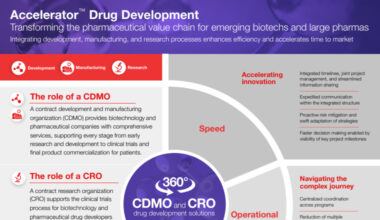
Putting integrated development into practice with Accelerator™ Drug Development
A modern, integrated CDMO+CRO services model from Thermo Fisher, designed for speed, scalability and flexibility.
Capabilities include:
- Single, integrated project timeline for all CDMO and CRO activities
- Strategic consulting (clinical, CMC, and regulatory)
- Preclinical and IND-enabling support for faster FIH milestone achievement
- GMP manufacturing and analytical development for small molecules, biologics and advanced therapies
- Clinical packaging, logistics and supply chain management
- Global, full CRO services across Phases I–IV and deep therapeutic expertise
- Central lab, data management, and statistical support
- Real world insights to drive innovation (RWE/RWD)
- AI-enabled documentation and real-time data visibility
Integration under a single partner eliminates traditional operational silos, enhances visibility and enables active collaboration and shared accountability across the entire project team.
Integration and early engagement are redefining success in oncology development
The convergence of scientific complexity, financial pressure, and competitive urgency is reshaping expectations for how drug development should be managed. Evidence across financial analysis, operational experience, and real-world execution leads to the same conclusion:
Early engagement with a single, integrated CDMO+CRO partner is one of the most effective strategies available for accelerating development, reducing risk, and maximizing program value.
Organizations that embrace this model gain a measurable advantage: faster timelines, streamlined operations, and a concept-to-market drug development strategy built for operational, regulatory and commercial success.
Gain speed, simplicity and scalability with our 360° CDMO and CRO solutions
Recommended for you