
Precision medicine’s blind spot: Why static data limits biomarker-driven drug discovery and development
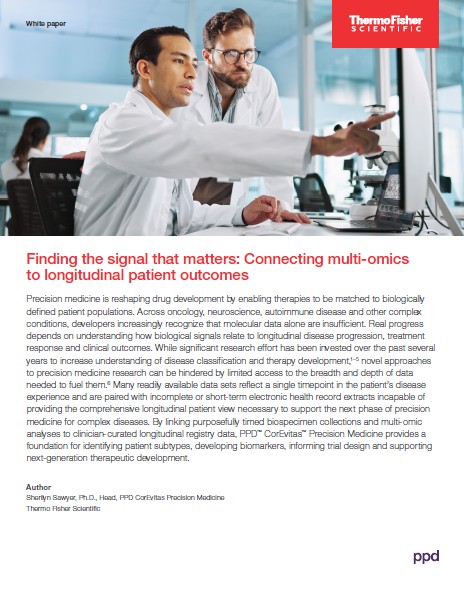
Precision medicine advances the ability to match therapies to biologically defined patient populations. But a promising molecular signal does not necessarily tell you which patients will benefit, how response will evolve or where a therapy has the strongest opportunity.
The challenge is moving from molecular signal to meaningful evidence. For complex, heterogeneous diseases, researchers need to understand how those signals relate to disease progression, treatment response and long-term clinical outcomes.
This white paper explores why the next phase of precision medicine requires moving beyond static molecular snapshots toward a more contextualized view of patient biology and clinical outcomes. Purposefully timed biospecimens, multi-omic analyses and clinician-curated longitudinal data uncover insights static datasets may miss and provide greater clarity for critical development decisions.
Discover how to use longitudinal clinical context to:
- Identify meaningful patient subtypes within heterogeneous disease populations
- Strengthen biomarker strategy by connecting molecular signals to patient outcomes
- Understand treatment-response trajectories, including durable benefit and loss of response
- Refine patient stratification and trial enrichment
- Support AI/ML discovery with clinically contextualized data
- Inform target, indication and clinical development decisions
What could your molecular data reveal if you could see the patient journey behind the signal?
Move from molecular signal to clinical meaning
Complete the form below to download the white paper.