
Turning R&D pressure into strategic opportunity
Insights from the 2026 Pulse Survey of global drug development leaders

An industry defined by complexity
The pharmaceutical industry continues to navigate a complex and increasingly uncertain environment. To better understand how sponsors are responding, The PPD™ clinical research business of Thermo Fisher Scientific surveyed 150 pharmaceutical and biotech leaders around the globe for The Pulse 2026. The findings reveal an industry balancing significant challenges while pursuing new opportunities to improve efficiency, accelerate development and deliver therapies to patients.
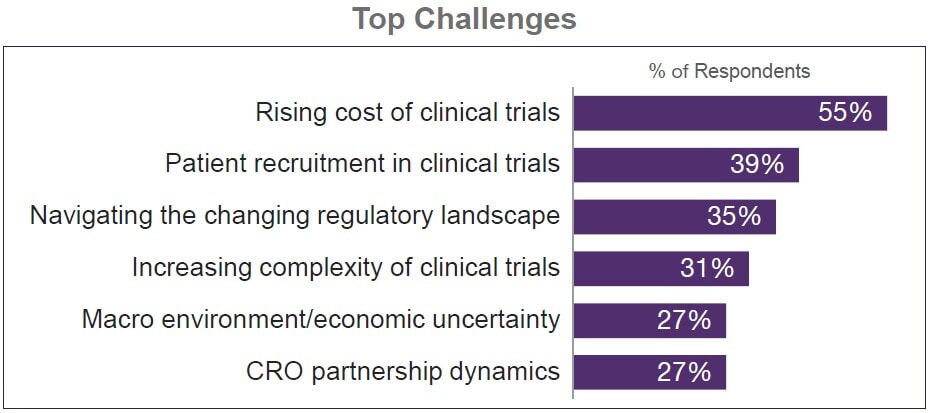
Today’s drug developers face pressure from multiple directions and these pressures are not occurring in isolation. Rising costs, recruitment hurdles, evolving regulations and increasingly complex study designs often intersect, creating ripple effects across the development life cycle.
Yet The Pulse 2026 findings also suggest that there are ways to transform these hurdles into opportunity. Across the industry, organizations are exploring innovative trial designs, investing in patient-focused strategies, adopting artificial intelligence and machine learning (AI/ML) technologies, and reevaluating operating models to improve resilience and efficiency. While uncertainty is inherent in drug development, there are opportunities to make more confident decisions despite it. The findings highlight several key challenges shaping pharmaceutical R&D today and the approaches organizations are taking to navigate them successfully.
Challenge 1
Rising clinical trial costs
Rising clinical trial costs are intensifying many of the pressures drug developers face today. More than half of survey respondents (55%) identified increasing trial costs as a top challenge, making it the leading concern in this year’s findings.
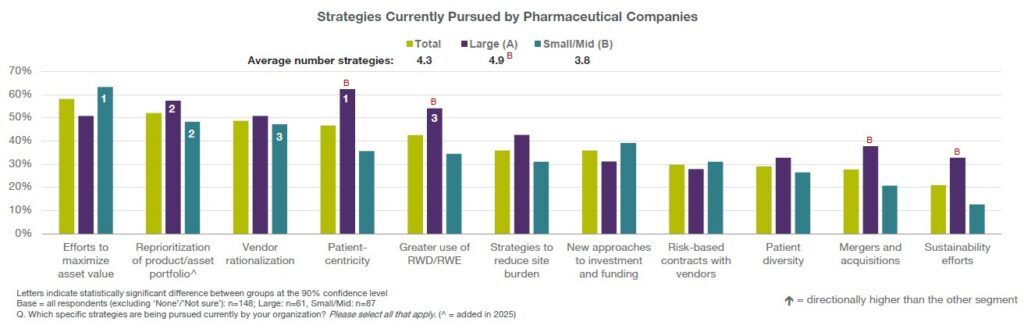
But cost pressure is rarely confined to one area of the drug development process. It influences decisions across the development life cycle, including:
- Which assets receive investment
- How protocols are designed
- When and where sponsors use external partners
- Which technologies are worth adopting
- How organizations define value and return on investment
That makes cost one of the clearest examples of how a challenge can also create a strategic inflection point. As sponsors look for ways to maintain momentum, many are moving beyond cost containment and toward more disciplined resource allocation. Innovative trial designs, stronger portfolio prioritization, vendor rationalization and operational efficiencies can all create opportunities to direct investment toward the programs with the strongest potential impact.
For many organizations, the focus has shifted from reducing spend alone, to ensuring every investment supports better decisions, stronger execution, and greater value for patients and stakeholders.
Challenge 2
Longer development timelines
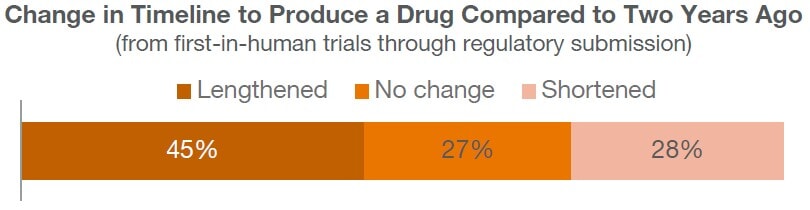
Speed remains critical in drug development, but many sponsors are finding it harder to maintain momentum. Forty-five percent of respondents report that development timelines have lengthened compared with two years ago, even as accelerating development remains a top organizational priority. These delays are being driven by a familiar mix of pressures, including more complex protocols, patient recruitment and enrollment challenges, and evolving regulatory requirements. When these factors overlap, they can slow execution, increase costs and make it harder for teams to plan with confidence.
The encouraging signal is that sponsors are actively working to change the trajectory. Nearly all respondents (97%) report taking steps to reduce development timelines, pointing to a broader shift toward earlier planning, more innovative trial designs, strategic use of AI/ML and outsourcing models that can add efficiency or specialized expertise. The most efficient path forward is about identifying where delays begin and designing development programs that reduce avoidable friction while maintaining study quality.
Challenge 3
Managing trial complexity
Clinical trial complexity has become one of the clearest examples of the balancing act facing drug developers. Sponsors are designing studies to meet increasingly sophisticated scientific, regulatory and operational goals, but that complexity can also add burden for patients, sites and study teams. It can contribute to higher costs, recruitment challenges, protocol amendments and longer timelines, creating friction in the very programs it is meant to strengthen.
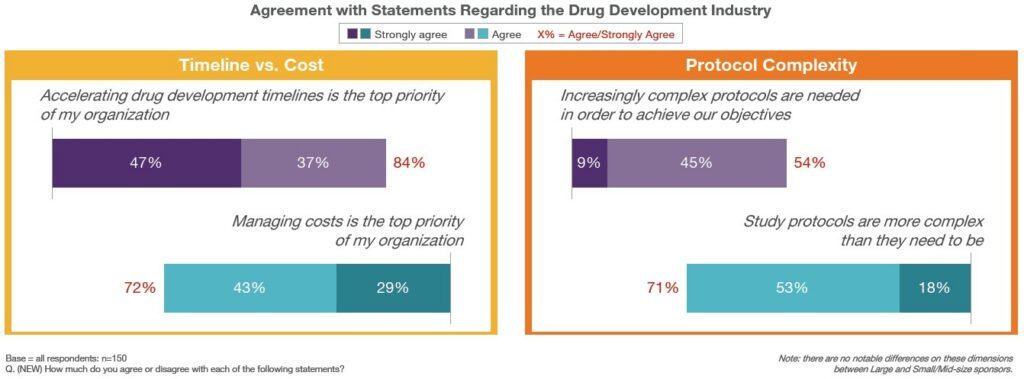
The findings capture this tension clearly: 71% of respondents agree that study protocols are more complex than they need to be, while 54% also agree that increasingly complex protocols are needed to achieve their objectives. This demonstrates that complexity is not always unnecessary, but it does need to earn its place in the protocol.
More complex trial designs may generate stronger data, support regulatory goals or answer additional scientific questions, but when complexity is added without a clear purpose, it can make studies harder to execute and harder for patients and sites to participate in. A more intentional approach to protocol design allows sponsors to preserve the rigor needed to meet development objectives while reducing avoidable friction. For organizations navigating pressure around cost, timelines and recruitment, that balance may be one of the most important ways to improve feasibility without compromising scientific value.
Challenge 4
Patient recruitment and engagement
Patient recruitment remains one of the most persistent challenges in clinical development, ranking as the second-highest challenge identified by sponsors. But enrollment is only one part of the issue. Retention and participation barriers can also affect study performance, making patient engagement a core factor in trial feasibility from the earliest stages of planning.
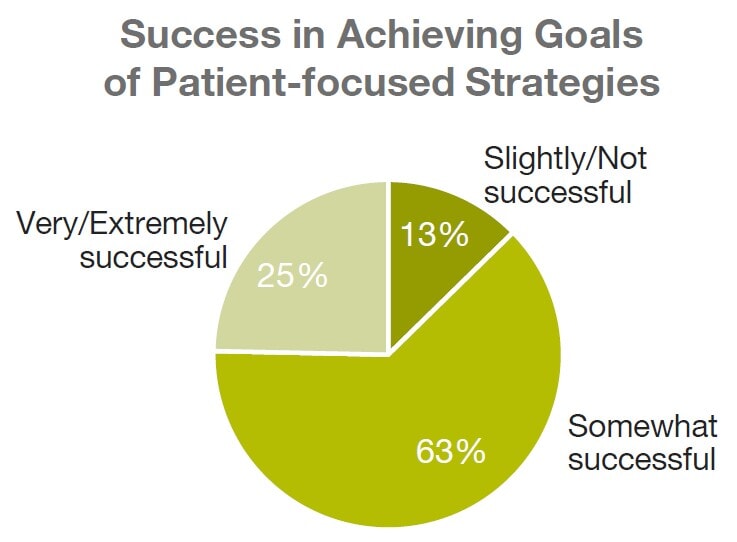
For sponsors, this creates pressure to design studies that are easier for patients to join, navigate and complete. The leading goals of patient-focused strategies reflect that need:
- Increase overall enrollment
- Improve patient retention rates
- Remove barriers to patient participation
Turning those goals into measurable progress requires patient-centric messaging alongside trial designs and engagement strategies that reflect the realities of participation. Patient-friendly technology, reduced visit burden, clearer communication and stronger support programs make studies more accessible while improving the overall trial experience. Greater use of patient experience data during protocol design also allow sponsors to identify barriers earlier, before they affect recruitment, retention or execution.
Challenge 5
Navigating regulatory change and industry uncertainty
A year ago, regulatory change was not among sponsors’ top 10 challenges. This year, it ranks third.
That jump says a lot about the environment in which drug developers are operating. Regulatory expectations are shifting alongside macroeconomic pressures, policy changes and broader uncertainty across the health care landscape. For sponsors, this can influence where studies are conducted, how evidence plans are built, how risk is assessed and how confidently organizations can make investment decisions.
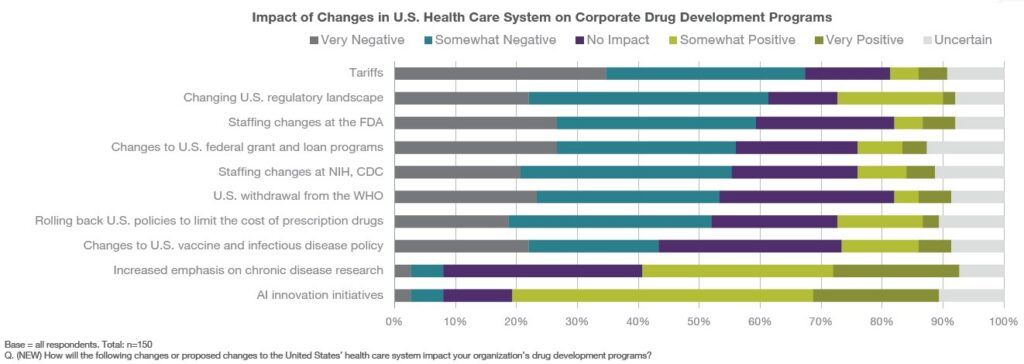
However, sponsors still need to be able to make decisions about assets, protocols, timelines and markets, often before the full implications of regulatory or policy shifts are clear. Waiting for perfect visibility can slow progress, but moving forward without enough flexibility can create risk later.
That is why this challenge also points to a meaningful area of opportunity. Organizations can strengthen the way they plan for change by building earlier regulatory input into study strategy, creating clearer decision pathways and using scenario planning to prepare for multiple possible outcomes. In a more dynamic environment, adaptability becomes the best way to maintain momentum. Sponsors that build flexibility into their development programs may be better positioned to adjust course as conditions evolve while continuing to advance promising therapies.
Challenge 6
Turning innovation into measurable impact
Artificial intelligence and machine learning have quickly become part of the drug development landscape, with organizations now using AI/ML across an average of 13.6 areas. That level of activity suggests the industry has moved well beyond early experimentation, applying AI/ML across functions such as data analysis, operational efficiency, predictive insights and scientific workflows. But as adoption expands, the central question is shifting from whether organizations are using AI/ML to whether those efforts are producing measurable value. Trust in AI predictions, integration with existing systems, and limited expertise or training resources remain the leading barriers to broader or faster adoption, and each can affect whether teams are able to use AI/ML confidently in day-to-day decision-making.
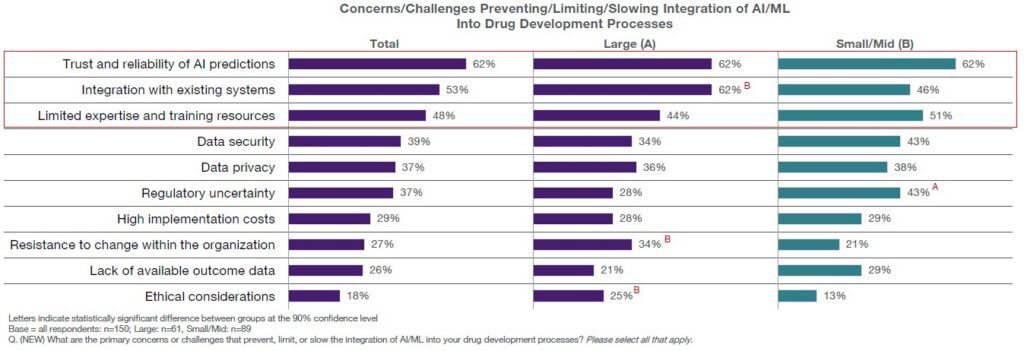
For sponsors, the next phase of AI/ML will likely depend on how well innovation is connected to practical development goals. Enhanced data analysis, predictive insights, improved operational efficiency and faster decision-making can all support more efficient development processes, but only when AI/ML is embedded into existing workflows, supported by appropriate governance, and paired with training that enables teams to understand and trust the outputs. As adoption continues, the organizations best positioned to realize value will be those that move beyond implementation alone and focus on outcomes teams can measure, trust and sustain.
The next phase of R&D resilience
Sponsors that approach today’s common industry hurdles as opportunities to strengthen strategy, execution and patient focus may be better positioned for long-term success. Rising costs can push organizations toward sharper portfolio decisions. Longer timelines can encourage earlier planning and more efficient trial design. Recruitment barriers can elevate the importance of patient experience. Regulatory uncertainty can strengthen scenario planning, while AI/ML adoption can prompt more disciplined approaches to technology, governance and measurable impact. For drug developers, these pressures create an opportunity to build more adaptive and patient-focused development strategies.
Looking ahead, the organizations best positioned for progress will be those that see the connections between challenges and respond with integrated decisions across study design, operations, patient engagement, technology and partnerships. The path forward will not be defined by eliminating complexity, but rather how effectively the industry turns challenge into opportunity, and opportunity into clearer strategy, stronger execution and better outcomes for patients.
Read the full Pulse 2026 report for deeper insights into the challenges and opportunities shaping pharmaceutical R&D.
Recommended for you