
The 2026 state of FSP outsourcing: challenges, trends, opportunities and the future of clinical development
How FSP partnerships enable sponsors to navigate uncertainty, accelerate innovation and deliver clinical trials with additional speed and flexibility.

Key takeaways
- Amid rising clinical trial costs, complexity, and other challenges, organizations are rethinking ways to resource clinical development
- Highlights from our 2026 FSP Trends Report reveal that FSP partnerships continue to help sponsors navigate these challenges
- Sponsors are further leveraging emerging FSP strategies to transform clinical development
Drug development has always been complex and is becoming increasingly unpredictable. Sponsors are balancing rising clinical trial costs, expanding protocol complexity, evolving regulatory expectations and persistent patient recruitment challenges, all while operating in an uncertain macroeconomic environment. As pressure mounts to deliver therapies faster and more efficiently, organizations continue to rethink strategies on how to resource clinical development.
The PPD™ clinical research business of Thermo Fisher Scientific published its fourth annual Pulse Report—an annual survey of 150 leaders from biotech and pharmaceutical organizations worldwide. Our 2026 FSP Trends Report highlights key survey insights from The Pulse and reveals that functional service provider (FSP) partnerships continue to play an increasingly strategic role in helping sponsors navigate these challenges. Rather than simply serving as a staffing solution, FSP models continue to lay the foundation for long-term partnerships that provide specialized expertise, global scalability and operational flexibility across the clinical development lifecycle.
Clinical development in 2026: More uncertainty, greater complexity
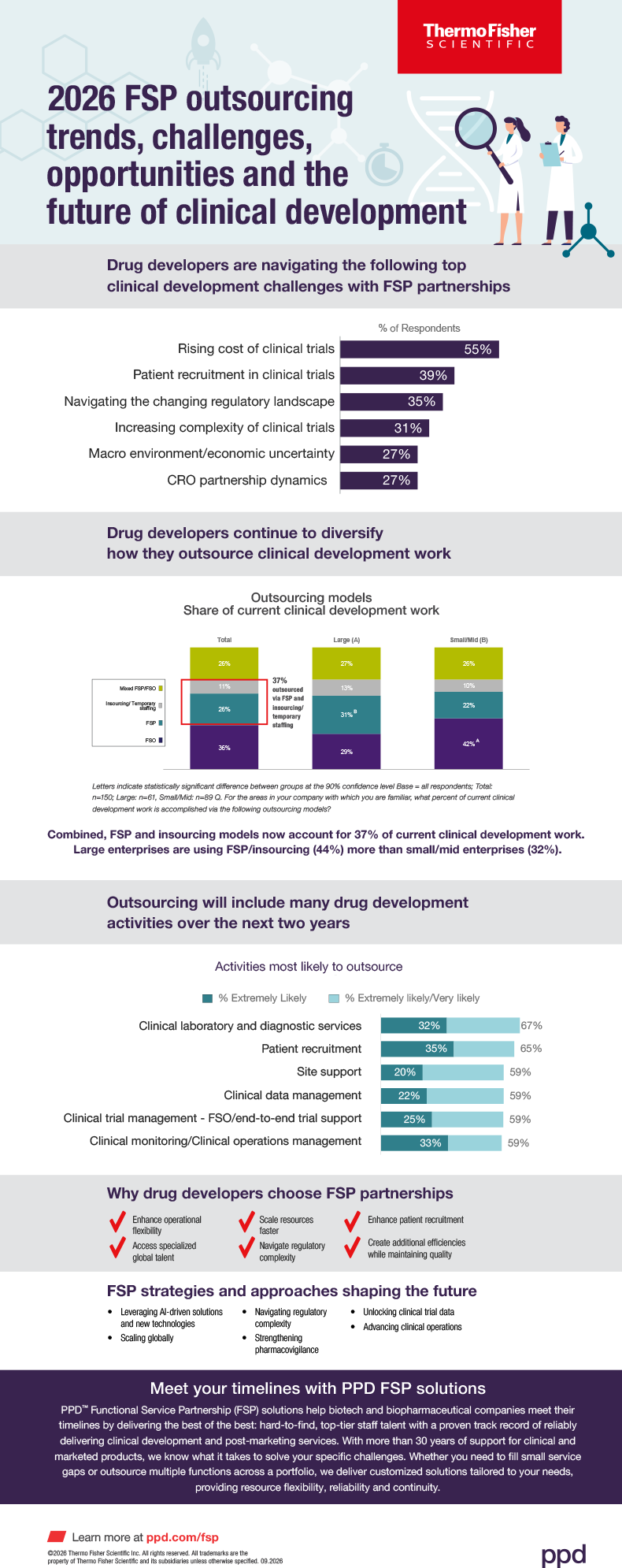
The current clinical development landscape reflects an industry facing unprecedented operational pressures. According to survey respondents, the top challenges impacting clinical development today include:
- Rising costs (55%)
- Patient recruitment (39%)
- Navigating the changing regulatory landscape (35%)
- Increasing complexity (31%)
- Macro environment/economic uncertainty (27%)
- Contract research organization (CRO) partnership dynamics (27%)
Notably, regulatory complexity has emerged as one of the industry’s fastest-growing concerns after not ranking among the top challenges in the previous year’s survey. At the same time, clinical trials continue to be more demanding, with Phase III studies now involving substantially more procedures, endpoints, countries and investigative sites than a decade ago.1
These pressures are driving organizations to seek outsourcing models that provide additional agility without sacrificing oversight or quality.
FSP outsourcing continues to gain strategic importance
The latest Trends Report shows that sponsors continue to diversify how they outsource clinical development work:
- 26% through mixed FSP/FSO models
- 11% through insourcing/temporary staffing
- 26% through dedicated FSP partnerships
- 36% through traditional full-service outsourcing (FSO)
Combined, FSP and insourcing models now account for 37% of current clinical development work, demonstrating the continued shift toward function-specific operating models. Large pharmaceutical organizations are leading this trend, relying on FSP models more heavily than smaller companies.
Many sponsors are combining approaches, using mixed FSP/FSO models to retain closer control of strategically important functions and access specialized expertise to augment end-to-end capabilities of FSO arrangements.
Sponsors are leveraging FSP partnerships to navigate the biggest clinical development challenges
Emerging FSP strategies shaping the current landscape, and beyond
As outsourcing models mature, the role of FSP partners continues to expand beyond traditional resourcing. Our FSP Trends Report highlights several emerging strategies transforming clinical development.
Meet your timelines with PPD FSP solutions
Today’s clinical development environment demands more than additional staffing. Sponsors increasingly require strategic partners capable of providing specialized expertise, global scalability, technology enablement and operational resilience throughout the clinical development lifecycle.
PPD™ Functional Service Partnership (FSP) solutions help biotech and biopharmaceutical companies meet their timelines by delivering the best of the best: hard-to-find, top-tier staff with a proven track record of reliably delivering clinical development and post-marketing services.
Because you can’t always predict—or find and retain—the staff and services you need, our experts deliver a breadth and depth of therapeutic and functional expertise unmatched in the industry, uniquely positioning us to deliver the right experience and knowledge to fill immediate resource and capability gaps.
To ensure projects launch on time and stay on budget, we employ dedicated transition and implementation roles and processes for swift deployment of staff and services, open, transparent and timely communications, and proactive problem-solving.
With more than 30 years of support for clinical and marketed products, we know what it takes to solve your specific challenges. Whether you need to fill small service gaps or outsource multiple functions across a portfolio, we deliver customized solutions tailored to your needs to provide much-needed resource flexibility, reliability and continuity.
FSP Trends Report
Download our FSP Trends Report and stay ahead of evolving FSP trends to confidently navigate today’s clinical development challenges—and prepare for tomorrow’s opportunities.
Source:
- Tufts CSDD Impact Report Volume 27, Number 6, November/December 2025 ↩︎